

PORCELAIN AS A MEDIUM
Trained in Sèvres at the Institut de céramique française in 2003, Alice Riehl commenced her artistic career in 2006. As a tribute to the needlework of her foremothers, the combination of porcelain and lace became a defining feature of her early practice. It offered a new life to these traditionally feminine crafts—often dismissed—and reinterpreted them through a hybrid material.
Recognized in 2010 for her work on seaweed-inspired motifs and her first wall pieces, she began to develop, through her wall sculptures, a distinctive personal style, one that evolved alongside a steadily refined technical mastery, enabling her to create increasingly complex pieces. During this period, she created several major installations for the Intercontinental hotel in Marseilles, Château Dauzac in Margaux, the Four Seasons Astir Palace in Athens and Palazzo Pamphilj on Rome’s Piazza Navona.
At the dawn of the 2020s, Riehl embraced a more radical artistic direction. She created Autoportrait, a hybrid between a peacock and a magnolia—an artwork acquired by Chaumet for its private salons on Place Vendôme in Paris. The compositions of her works have grown more intricate, and the sculptural detailing increasingly meticulous. Her style asserts itself through works of contrasting formats—monumental (Alter Ego) or ethereal (Verve, Dent-de-Lion). She draws more explicitly from the world of tapestry (Millefleurs) and feminist mythology (Songe). Her glaze palette continues to expand, introducing unexpected shades that give each piece its own distinctive atmosphere (Échappée, Songe, Souffle, Timidité).
Resulting from her residency at Villa Albertine in New York in 2025, two concurrent solo museum exhibitions take place in 2026 and through 2027 at Museum of Arts and Design in New York and Musée de la Toile de Jouy in France. She is represented by Todd Merrill Studio.
SELECTION OF PRESS ARTICLES
- M Le Monde – April 2026 “Au Musée de la toile de Jouy, une fresque en porcelaine parfumée à voir et à sentir” Read here
- Beaux Arts Magazine – April 2026 “Alice Riehl fait pousser un arbre de porcelaine plein d’humanité à Jouy-en-Josas” Read here
- AD Architectural Digest March 2024 «This Grand Duplex Penthouse in New York City Is a Modern-Day Castle in the Sky » Read here
- Financial Times Oct. 27th, 2023 « The botanical fantaisies created by wall-mounted ceramic plants » Read here
- La Revue de la Céramique et verre n°196, May/June 2014
« Alice Riehl, Décrocheté sauvage » - Les Echos 24th January 2014
« Les métiers d’art jouent la French Touch » - Financial Times HTSI April 2013 « A great relief »
- Connaissance des Arts N°679, February 2010
- La Revue de la Céramique et du Verre N°156, Sept-Oct 2007,
« Alice Riehl, le fil et la forme » - Elle Décoration N°162, April 2007, « Alice Riehl, la dentellière de porcelaine »

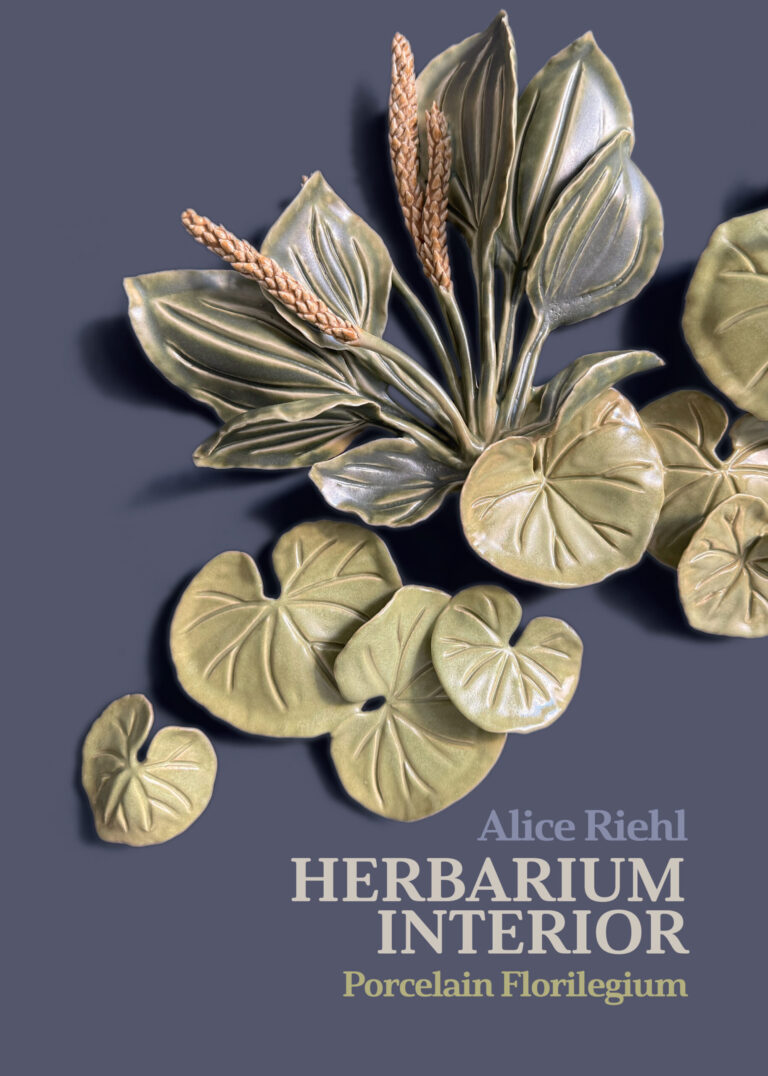
CATALOGUE / MONOGRAPH
HERBARIUM INTERIOR - PORCELAIN FLORILEGIUM
Published to accompany the twin exhibitions Herbarium Interior at the Musée de la Toile de Jouy in France (March 27–May 24, 2026) and Porcelain Florilegium at the Museum of Arts and Design in New York (February 2026–April 2027), this catalogue/monograph brings together the recent body of work developed from Alice Riehl’s residency at Villa Albertine in New York.
For nearly two decades, French artist Alice Riehl has explored our relationship with the plant world through large-scale porcelain wall installations inspired by plants and shaped by the narrative and symbolic language of tapestries. Drawing on the botanical motifs of toile de Jouy and her observations of New York’s plants, landscapes and inhabitants, Herbarium Interior invites us to reconsider our connection with the living world.
How can we learn to see plants more attentively? What keeps us apart from the natural world, and from one another? And what new ways of seeing might help us imagine a shared narrative?
The publication brings together twelve of Riehl’s most recent and significant works, including three presented in Porcelain Florilegium. Together, these works reflect her ongoing attempt to establish a connection with the “absolute otherness” of plants and trees.